
25 years after the formation of the Sydney Harbour Trust we are once again faced with the threat of a sell off of Defence lands at Middle Head.
HPG opposes the planned divestment of HMAS Penguin.
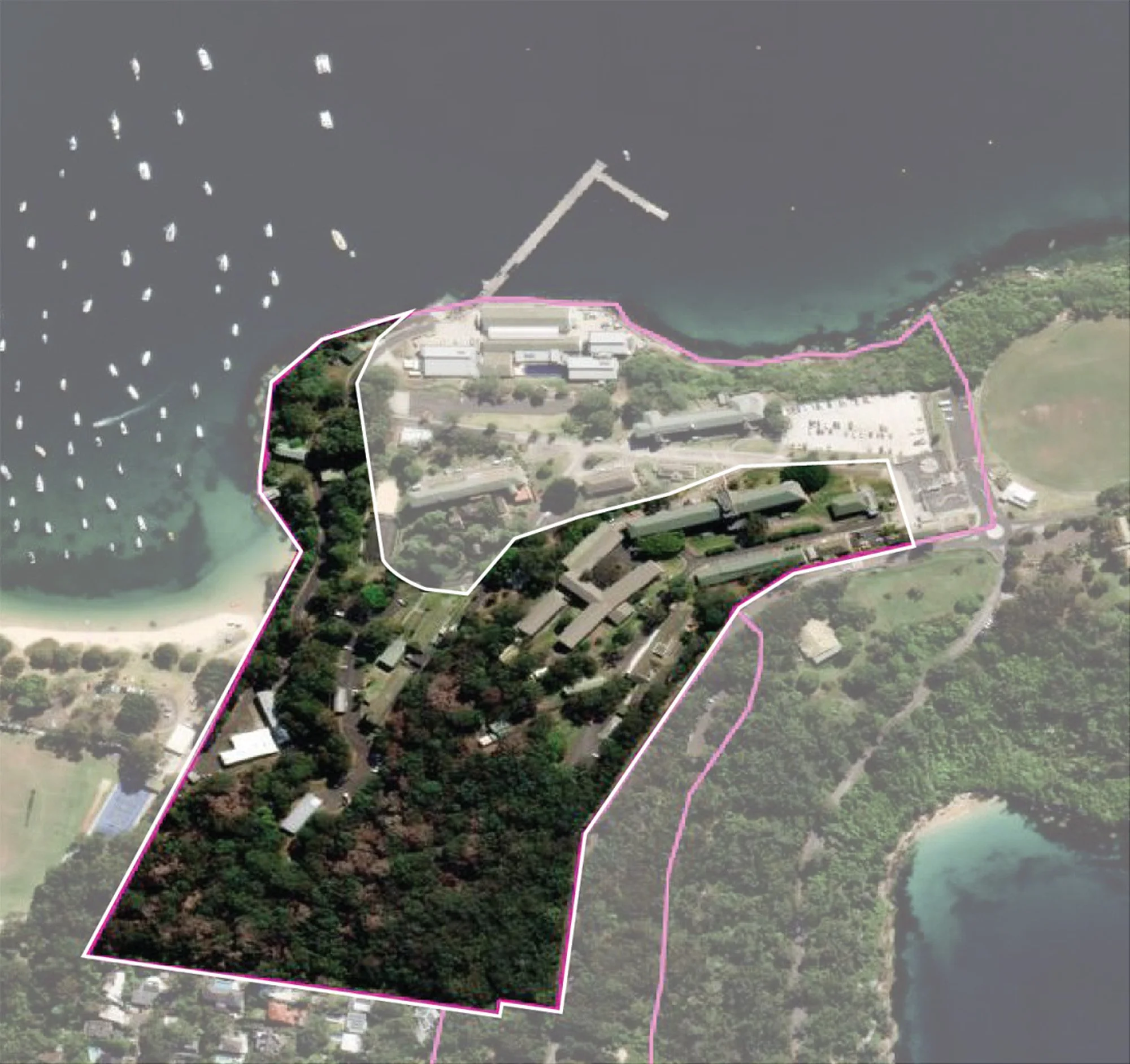
IMAGE: Planned divestment of land at HMAS Penguin on Middle Head from the Defence Department website
Background
The Headland Preservation Group (HPG) was formed in 1996 in response to the Howard Government’s proposed sale of former Defence land at Middle Head for housing.
Following strong community advocacy — notably from Jack Mundey and Bob Carr — the Howard Government in 2001 returned the land to the people of Australia as a gift marking 100 years of Federation. The Sydney Harbour Federation Trust was established to manage these lands and to conserve, preserve and interpret their cultural, heritage and environmental values for present and future generations.
Fast forward to today, and another sell-off has been announced — this time by the Albanese Government. It is deeply ironic that the Labor Party, which once helped protect this land, is now proposing to divest part of Middle Head, one of our most precious heritage landscapes.
The Federal Government has confirmed the partial divestment of the 16.64-hectare HMAS Penguin site at Balmoral on Middle Head. While critical Defence capabilities are to be retained, other portions of the historic Commonwealth-listed site are to be sold — potentially to private developers or possibly converted to parkland. At present, the exact boundaries of the land proposed for sale remain unclear.
Description of the Site
HMAS Penguin is part of the historic defence installations that define Middle Head. The land was dedicated to defence purposes by 1870 as part of the Middle Head–Georges Heights headlands, which were strategically vital in defending the approaches to Sydney Harbour through the Heads.
The military heritage of Middle Head is unparalleled in Australia, spanning more than 200 years. A military presence was first established there in 1801 to protect the colony of New South Wales during the Napoleonic Wars. That presence has continued to the present day, with HMAS Penguin remaining a strategic military asset.
HMAS Penguin comprises:
A built environment constructed between 1940 and 1945 during World War II important for its Inter-War Classical Style of architecture and of exceptional significance as a purpose-built naval training and hospital complex.
Several hectares of exceptional native bushland, including a spectacular Angophora forest of remarkable environmental and aesthetic value.
Both the built environment and the native Angophora forest are Commonwealth Heritage Listed, Place ID 105581.
Context
The proposed sale appears to be driven by the need to fund new military equipment and reduce maintenance costs associated with under-utilised heritage properties.
Finance Minister Katy Gallagher has stated that asset sales will be determined on a case-by-case basis. She has said, “I am hopeful some of that would be for housing, but it really is to be determined, and no decision has been made.”
Each property may indeed require individual assessment. However, the heritage and environmental values of HMAS Penguin demand exceptional caution.
Impacts of the Proposed Sale
If parts of the built environment are sold, the heritage buildings must be fully protected and their future use carefully determined. Any new development must be assessed for its impact on the existing heritage fabric.
As Defence Minister Richard Marles has acknowledged: “The heritage value of these properties does not belong to… the Australian Defence Force. It belongs to the people of Australia.”
It is therefore contradictory to propose selling elements of this heritage environment to private developers.
If the divested area includes the Angophora forest, the implications are even more serious. Maintenance costs for Defence would have been minimal and would likely remain so. The financial gains from selling this land for development, however, would be substantial.
There is little reason to believe that affordable housing would be delivered on such a premium site. Given its location and harbour views, it is far more likely that luxury housing would be constructed.
Richard Marles has stated that housing may be part of the opportunity, but “that is not why we are doing this.” If housing is not the primary objective, it is difficult to see why the Government would sell such valuable land for public parkland rather than pursue higher financial returns.
Public and Environmental Significance
The Angophora forest is extraordinary. It stretches from Middle Harbour across the Middle Head ridgeline to Sydney Harbour. It is ecologically significant, visually stunning, and forms part of the 80-kilometre Bondi to Manly coastal walk, visited by thousands of people each year.
This land provides an important public benefit.
Sydney Harbour defines not only Sydney, but Australia internationally. Often described as one of the most beautiful harbours in the world, its values must be protected.
The natural headlands — North Head, Middle Head and Bradleys Head — frame the Harbour and provide rare natural respite within an increasingly urbanised city. These landscapes are the “lungs” of Sydney. They must not be compromised by further urban development.
Middle Head has long been described as the jewel in the crown of Sydney Harbour. We must not sell the Crown jewels.
Conclusion
The proposed divestment of parts of HMAS Penguin risks significant harm to the heritage and environmental values of this nationally important site.
It is unlikely to meaningfully address housing affordability, given the premium nature of the land. Instead, it risks facilitating luxury development at the expense of public benefit.
All sides of politics should oppose the sale of this highly prized public asset and ensure that the heritage, environmental and community values of Middle Head are protected for future generations.